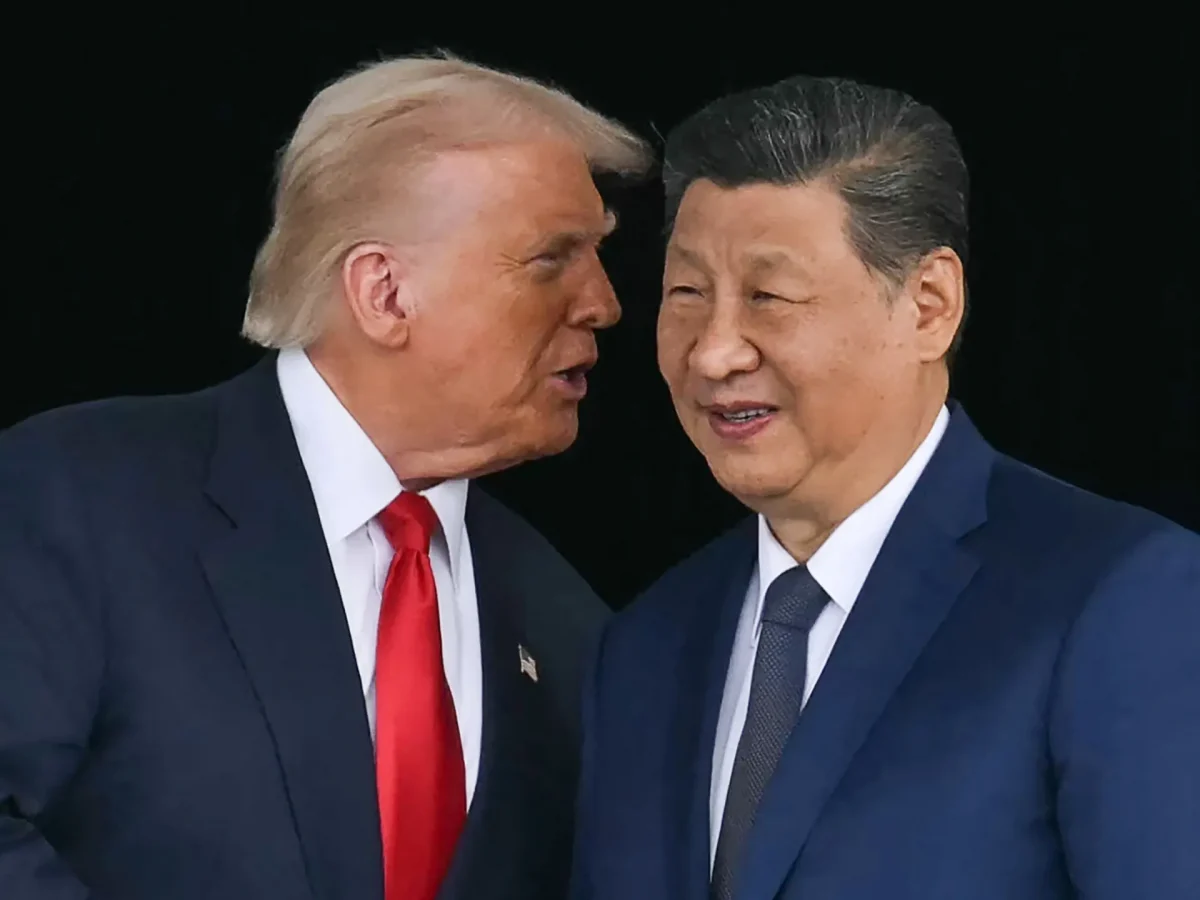
United States President Donald Trump has hailed his Wednesday phone call with his key trade rival, China’s President Xi Jinping, in which they discussed a wide range of issues, as “excellent”.
But while Trump, who hopes to persuade China to further isolate Iran, claimed after the call that China had promised to increase the volume of soya beans it buys from the US, Xi appeared more concerned with warning the US to stay away from Taiwan.
Recommended Stories
list of 4 itemsend of list
In a post on his Truth Social website, Trump described the conversation as “excellent” and claimed the two countries are on friendly terms. Relations between the two countries have been rocky, however, and last year, Trump instigated a bitter trade war with Beijing.
“The relationship with China, and my personal relationship with President Xi, is an extremely good one, and we both realize how important it is to keep it that way,” Trump wrote in his post on Wednesday.
The two leaders were understood to have discussed a planned trip by the US president to Beijing later this year, Trump said, adding that he was “looking forward to it”.
China reacted in a more muted manner to the call, with state media reporting that both sides discussed opportunities to meet in the coming year. There was no mention of Trump’s visit to Beijing, nor of buying soya beans.
According to China’s state news agency Xinhua, Xi told Trump that he was willing to “work with you to steer the giant ship of China-US relations steadily forward through winds and storms, and accomplish more big things and good things”.
While the call indicates that both sides wish to keep talks on an even keel, it does not disguise the competing interests of each, analyst Manoj Kewalramani of the India-based Takshashila Institution told Al Jazeera.
“Implicit in this is the understanding the relationship is likely to remain difficult owing to the underlying strategic competition (between them),” he added.
Beijing is set to host the Asia-Pacific Economic Cooperation (APEC) Leaders’ Meeting in November. The US, meanwhile, is hosting the G20 Summit in December.
The two leaders last held a phone call in November to discuss several topics, including trade, amid the US’s tariff war. Trump’s erratic trade policies caused Chinese exports to the US to fall, but also saw Beijing’s exports to other countries soar last year.
Here’s what we know about the latest phone call and what it means for US-China relations:

What was discussed regarding Taiwan?
Both sides confirmed that several topics were discussed, but the Chinese government, in its statement, said the “most important issue” was Taiwan.
China has long made known its plans to “reunify” with the democratic island it views as part of its own territory, and has not explicitly ruled out using force to do so.
Historically, the US has been an ally of Taiwan. Past administrations have maintained a “strategic ambiguity” position, which does not clearly rule in or out that Washington would step in to defend Taipei in case of a Chinese attack – leaving Beijing guessing.
Unlike previous governments, however, Trump has not prioritised support for Taiwan and has instead focused on making deals.
The US’s 2026 National Defense Strategy, published last month, made no mention of Taiwan, although earlier versions of it noted China’s “provocative” overtures in the waters close to Taiwan. Most recently, China held military drills in the waters and airspace around Taiwan’s main island in late December last year.
In December, the US announced a huge arms sales package to Taiwan valued at more than $10bn, including medium-range missiles, drones and howitzers, drawing anger from China.
Xi told Trump on the Wednesday phone call to handle any weapons sales to Taiwan with “prudence”, according to Chinese state media.
The Chinese leader also warned that Taiwan was part of “China’s territory”, and that China “must safeguard its own sovereignty and territorial integrity”, the Xinhua news agency reported.
“China will never allow Taiwan to be separated,” state broadcaster CGTN quoted Xi as saying.
Has Trump persuaded China to buy more US goods?
China and the US are the world’s largest economies and are also important trading partners. However, the US imports more from China than it exports to the country, with the trade deficit reaching about $300bn by 2024. This trade imbalance is what Trump sought to change when he slapped tariffs on China of 145 percent last year.
The US’s top export to China is soya beans. Following his call with Xi on Wednesday, the US president claimed the two had discussed Beijing’s purchase of US oil, increased purchase of US soya beans and the delivery of aeroplane engines. However, this has not been specifically confirmed by China since the call between Trump and Xi.
China has shown some willingness to cede to these sorts of demands from Trump, however. The country’s state-run Sinograin and COFCO have already bought about 12 million tonnes of US soya beans since October trade talks with the US, paying close to $100m more than they would have done for Brazilian beans.
“Is there a market logic at the moment for China procuring a bunch more US soya beans, just as Brazil’s harvest comes in? No,” Even Rogers Pay, director of Beijing-based consultancy Trivium China, told the Reuters news agency on Thursday. “But could it smooth the path for an even more productive and lucrative state visit by Trump in April? Perhaps.”
Last year’s trade war between Washington and Beijing saw both sides increase tariffs in a series of announcements. US tariffs on Chinese imports reached 145 percent, while China’s retaliatory taxes reached 125 percent. Following negotiations and an in-person meeting between Trump and Xi in South Korea in October, the US reduced tariffs to 47.5 percent while China lowered them to 31.9 percent.
“Beijing is particularly pleased with its own handling of the trade war with the United States, which Chinese analysts largely view as having played out to China’s advantage,” said analyst Patricia Kim of the Brookings Institution.
“From their perspective, President Trump’s evident desire to reach a trade deal with China, combined with the expectation of multiple leader-level engagements over the course of the year, has effectively bought China time and strategic breathing room from the most hawkish policy impulses in Washington,” she added.
What other bones of contention exist between Trump and Xi?
Iran
Trump said the two leaders discussed “the situation in Iran” among other topics.
Tensions between Washington and Tehran are currently high due to the Iranian government’s deadly crackdown on wide antigovernment demonstrations that were held between December and early January.
Trump has also said he’s considering military action in Iran that analysts say could lead to government change there. Since late January, the US has been amassing military forces in the Arabian Sea, triggering concerns of a potential Venezuela-style US invasion that saw President Nicolas Maduro abducted and taken to the US to be tried on guns-and-drugs charges in December.
The US, which attacked three Iranian nuclear sites during last July’s Iran-Israel war, has been pressing Tehran to abandon its nuclear programs and not enrich uranium at all, even for civilian purposes.
Iran has repeatedly resisted US orders, insisting it doesn’t have plans to manufacture military-grade nuclear weapons. US and Iranian officials are expected to hold talks in Oman on Friday on the issue.
Last week, the US announced sanctions on unnamed Iranian government officials it said were responsible for the crackdowns on protesters. Washington has long imposed sanctions on Tehran, which have significantly weakened the Iranian economy.
In January, Trump announced a new 25 percent trade tariff on countries trading with Iran, in a bid to pressure and isolate Tehran.
China is Iran’s largest trading partner and buys most of Iran’s oil. It’s unclear, however, if Trump directly asked Xi to stop buying Iranian oil in the way he has pressured India to stop buying Russian oil. China has not commented on this.

Russia
The leaders also discussed Russia’s war in Ukraine.
China is a strong ally of Russia and its largest buyer of oil. Both have sought to present a strong front, and Beijing has never denounced the invasion of Ukraine in February 2022.
The US, meanwhile, is attempting to secure a permanent ceasefire to the four-year Ukraine war. This week, Russian and Ukrainian officials are meeting in Abu Dhabi in talks brokered by the US.
Beijing imports Russian oil, coal, timber and copper. Amid Western sanctions on Russia, Beijing’s trade with Moscow has proven an economic lifeline, particularly as Washington has successfully used tariffs to force countries like India to stop buying Russian oil.
Both are founding members of the BRICS economic bloc, which stands for the original member countries Brazil, Russia, India, China and South Africa. Iran, which also joined, participated last month, together with Russia and China, in military training in South Africa.
President Xi separately held a phone call with Russian President Vladimir Putin also on Wednesday and said both sides would continue working together strategically, although neither went into details. There was no mention of Ukraine.
Beijing has so far shown no signs of scaling back its trade relations with Russia or Iran, experts say, and is not likely to do so.
“Chinese officials frame its economic relationships as matters of sovereignty and principle, and insist they will continue trading with partners of their choosing,” Kim of the Brookings Institution said.
The Trump administration has not explicitly tied progress in the two countries’ trade negotiations to exerting economic pressure on Moscow or Tehran, and that “makes it easier for Beijing to disregard those requests”, Kim said.
Critical minerals
Critical minerals have been a recurring source of tension between the two countries. Important minerals, which include rare earth metals like samarium and promethium, are important for the manufacture of high-tech gadgets and devices, from smartphones and electric cars to fighter jets.
China currently dominates the mining and processing of such minerals, but the US wants to break that hold. Last year, China tightened export controls on rare-earth metals amid its tense trade war with the US. The move dealt a blow to US supplies and affected US industries that are highly reliant on Chinese supplies.
Following a truce called by Trump and Xi in October last year, Beijing has paused some of these restrictions, but experts say its dominance remains a key leverage in dealing with the US.
On Monday, Trump announced a new $12bn US critical mineral reserve – “Project Vault”, in a bid to boost US stockpiles. He has also held a critical minerals “ministerial” with representatives from 50 countries in Washington this week, to discuss ways to diversify supply chains and break China’s stranglehold.
On Wednesday, during that ministerial, US Vice President JD Vance proposed a critical mineral trading bloc, with South Korea, India, Thailand, Japan, Germany, Australia, and the Democratic Republic of the Congo, among others, in attendance.