Idrees Ali and Phil Stewart
Updated ,first published
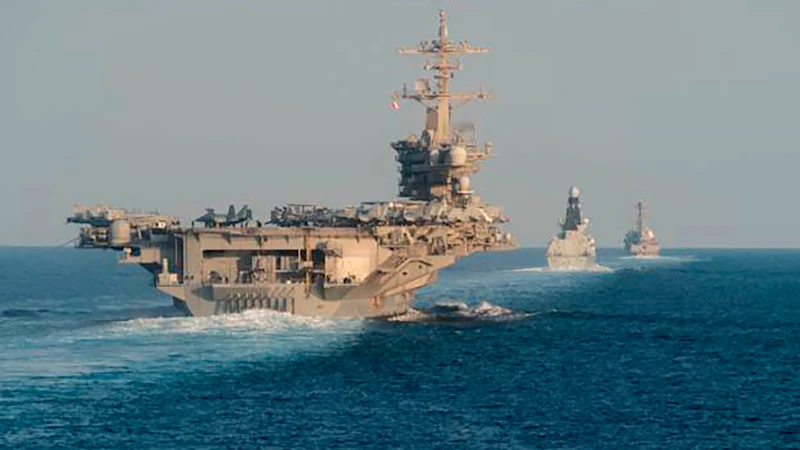
The US military said it shot down an Iranian drone that “aggressively” approached the Abraham Lincoln aircraft carrier in the Arabian Sea.
The incident came as diplomats sought to arrange nuclear talks between Iran and the US, and President Donald Trump warned that as American warships head toward Iran, “bad things” would probably happen if a deal could not be reached.
The Shahed-139 drone “aggressively approached” the Abraham Lincoln with “unclear intent” and kept flying toward it “despite de-escalatory measures taken by US forces operating in international waters,” Navy Captain Tim Hawkins said in a statement.
The drone was destroyed by one of the carrier’s F-35 fighter jets, Hawkins said. No American service members were harmed, and no equipment was damaged.
The incident occurred within hours of Iranian forces harassing a US-flagged and US-crewed merchant vessel sailing in the Strait of Hormuz near Iran, the American military said.
Iranian state media reported that Iran’s paramilitary Revolutionary Guard was investigating the “interruption” of the drone. The semi-official Tasnim news agency reported on Telegram that, before the footage cut out, the drone successfully transmitted the images it had taken back to Iran.
Iran’s UN mission declined to comment.
The developments could escalate the heightened tensions between the longtime adversaries as Trump has threatened to use military action first over Iran’s bloody crackdown on nationwide protests and then to try to get the country to make a deal over its nuclear program.
Iran has demanded that talks with the US scheduled this week be held in Oman, not Turkey, and that the scope be narrowed to two-way negotiations on nuclear issues only, a regional source said on Tuesday, adding new complications to an already delicate diplomatic effort.
A diplomat with knowledge of Iran’s demands said Tehran sought “to change the format, they want to change the scope”.
“They only want to discuss the nuclear file with the Americans, while the US wants to include other topics such as the (ballistic) missiles and the activities of Iran’s proxies in the region.”
The Lincoln carrier strike group is the most visible part of a US military build-up in the Middle East following a violent crackdown against anti-government demonstrations last month, the deadliest domestic unrest in Iran since its 1979 revolution.
In a separate incident in the Strait of Hormuz, just hours after the drone was shot down, Iran’s Islamic Revolutionary Guard Corps forces harassed a US-flagged, US-crewed merchant vessel, according to the US military.
“Two IRGC boats and an Iranian Mohajer drone approached M/V Stena Imperative at high speeds and threatened to board and seize the tanker,” Hawkins said.
Maritime risk management group Vanguard said the Iranian boats ordered the tanker to stop its engine and prepare to be boarded. Instead, the tanker sped up and continued its voyage.
Hawkins said a US Navy warship, the McFaul, was operating in the area and escorted the Stena Imperative.
“The situation de-escalated as a result, and the US-flagged tanker is proceeding safely,” Hawkins added.
‘Fair negotiations’
Iran’s president said on Tuesday that he instructed the country’s foreign minister to “pursue fair and equitable negotiations” with the US, marking one of the first clear signs from Tehran that it wants to try to negotiate with Washington despite a breakdown of talks last summer.
Turkey had been working behind the scenes to make the talks happen there later this week, as Trump’s Middle East envoy Steve Witkoff is travelling in the region. A Turkish official later said the location of talks was uncertain but that Turkey was ready to support the process.
Trump has said he would “like to see a deal negotiated”.
“Right now, we’re talking to them, we’re talking to Iran, and if we could work something out, that’d be great. And if we can’t, probably bad things would happen.”
The US military has been moving assets into the region over the past several weeks, including the Lincoln and several destroyers, which arrived last week.
The carrier strike group, which brought about 5700 additional service members, joined three destroyers and three littoral combat ships that were already in the region.
Analysts of flight-tracking data have also noticed dozens of US military cargo planes heading to the Middle East.
The activity is similar to last year when the US moved in air defence hardware, such as a Patriot missile system, in anticipation of an Iranian counterattack following the American bombing of three key nuclear sites. Iran launched more than a dozen missiles at Al Udeid Air Base in Qatar days after the strikes.
The US has several bases in the Middle East, including Al Udeid, which hosts thousands of American troops and is the forward headquarters for US Central Command.
Reuters, AP
Get a note directly from our foreign correspondents on what’s making headlines around the world. Sign up for our weekly What in the World newsletter.