
Listen to this article
Estimated 4 minutes
The audio version of this article is generated by AI-based technology. Mispronunciations can occur. We are working with our partners to continually review and improve the results.

Follow Winter Olympic SportsPersonalize Your Feed
Chris Jones reports from Milan.
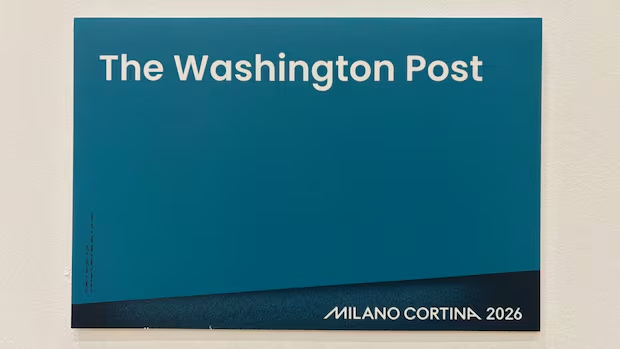
In the last hours before these Olympics begin, and the flame is lit, and the cheering starts, a smaller, sad drama played out in a little white box of an office in the Main Media Centre in Milan. A sign on the door read: The Washington Post.
Behind that door, two sportswriters, Rick Maese and Les Carpenter, worked in a space with enough chairs for six.
There had been rumours for weeks that the Post’s vaunted sports section — the last great newspaper sports section in America — was going to be eliminated on Wednesday in widespread cuts.
The Post had planned on sending 12 journalists to the Olympics, but its executives had decided to eat $80,000 in sunk travel costs rather than lay them off while they were on the road. After an internal and external outcry, the executives changed course and sent a skeleton crew of four, including Maese and Carpenter.
The rumours of a Wednesday dispatching proved true. An all-hands Zoom call was scheduled for 2:30 p.m. local time, 8:30 a.m. in Washington. Maese and Carpenter sat in silence and watched it together. Their section was gone, part of a larger restructuring ordered by owner Jeff Bezos, the Amazon founder and fourth richest person in the world.

There was a little hope left. Some members of the department would be moved to another section. Employees were told that they would receive an email after the call informing them whether they would be let go or retained.
At 3:00 p.m. in Milan, Carpenter opened his email. “I’m out,” he said.
Maese was told shortly after that he had been kept.
“Congratulations,” Carpenter said to his friend.
Outside the door, the usual buzz of anticipation continued. The Olympics are a kind of giant machine, an enormous engine driven by muscle and memory and desire. Hundreds of reporters sat at long rows of folding tables, filing their previews, making their predictions, planning which events to watch and when.
Inside that little white box in the media centre, however, the air had gone heavy with something close to the strange, liminal feeling that follows a death in the family: You want the world to stop spinning for even a moment, to acknowledge, however briefly, that nothing is the way it was.
You want to scream at it to stop.
Word spread. A member of the U.S. delegation was the first to open the door and offer his commiserations. Next came a writer from the rival New York Times. They provided what small comforts they could, and then they left to do what they had been doing before.
The world doesn’t stop, no matter how loud you scream at it.
These Olympics, vast and relentless, won’t stop either.

It wouldn’t matter that rain was pouring down in Milan, or that some of the venues aren’t quite finished, or that some of the athletes who’ve worked so hard to be here — Canadian figure skater Deanna Stellato-Dudek, American skier Lindsey Vonn — risked not competing because of bad luck and injury.
It wouldn’t matter that these Olympics will likely be the last covered by the Washington Post.
The Games will go on.
So, too, will Les Carpenter. The long-time journalist, married with two children, will stay in Milan and finish his assignment.
There was an element of forbearance in his continuing to work. Until the guild negotiates its settlement with the Post, he will remain an employee. He will remain a sportswriter. He’s here, and there is no point or pride in sitting in a bar or heading back home.
But something larger, grander, affirmed his determination to stay.
Maybe more than ever, he needs to watch Olympians do the magnificent things that they do. For the next 19 days, Carpenter will thrill as figure skaters jump, speed skaters race, and hockey players battle, and he will try to find beauty and inspiration in it all and pass that beauty and inspiration along to his readers, the way he’s done for decades.
“People are still paying for the paper,” he said. “They’re owed something.”
What he’s owed will be decided by different people in different rooms.
He turned to his laptop. In that little white box of an office, it was time to get back to work.