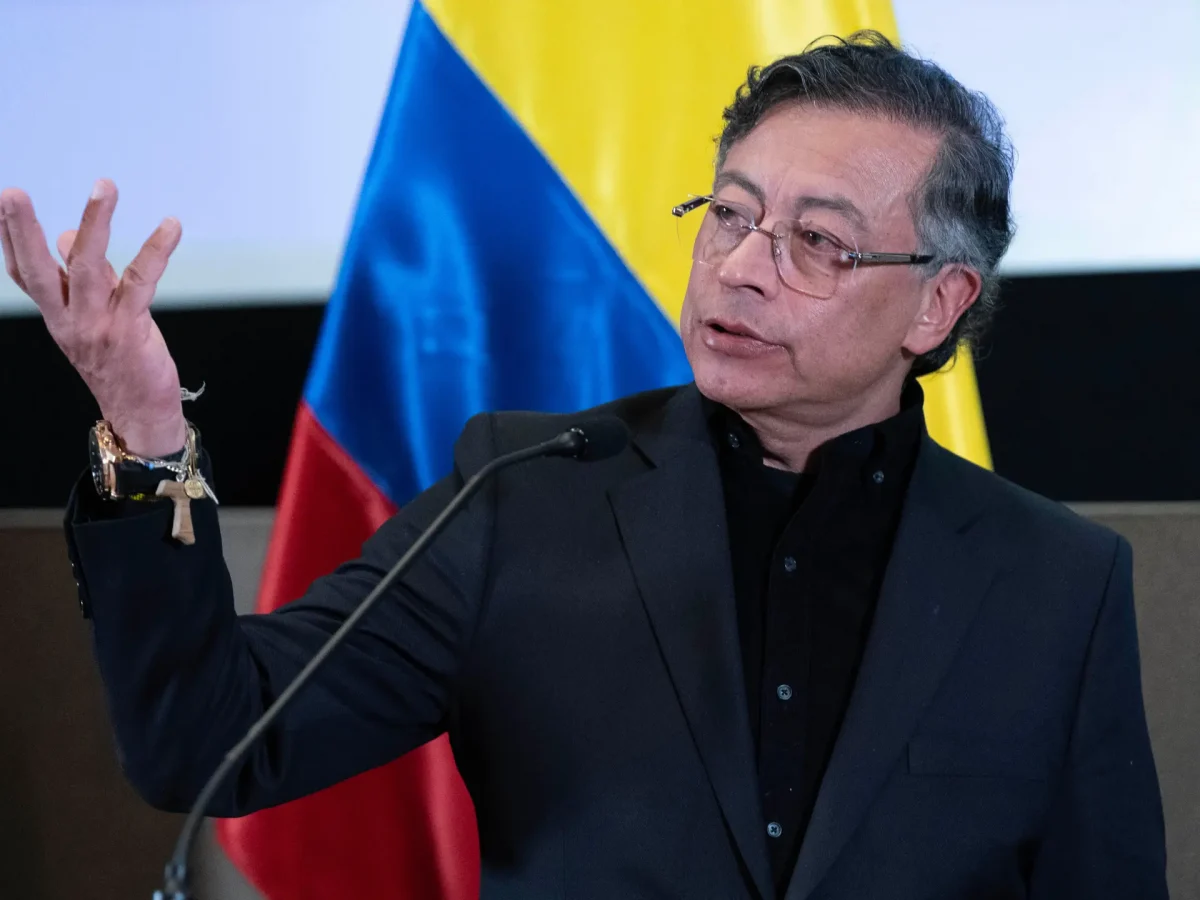
The Gaitanist Army of Colombia (EGC), the country’s largest criminal organisation, has announced it will temporarily suspend peace talks in Qatar after Colombian President Gustavo Petro reportedly pledged to target its leader.
In a social media post on Wednesday, the EGC, sometimes referred to as the Gulf Clan, indicated the suspension would continue until it received updates from the Petro administration.
Recommended Stories
list of 3 itemsend of list
“By order of the Joint Chiefs of Staff, the EGC delegation at the negotiating table will temporarily suspend talks with the government to consult and clarify the veracity of the information,” the group wrote in a statement on X.
“If the media reports are true, this would be a violation of good faith and the Doha commitments.”
Colombia’s Defence Minister Pedro Sanchez confirmed the reports later on Wednesday, sharing a list of three drug “kingpins” that Petro’s administration would prioritise as “high-level targets”.
Among the three targets was the EGC’s leader, Jesus Avila Villadiego, alias Chiquito Malo. A reward for his capture was set at 5 billion Colombian pesos, equivalent to $1.37m.
The other two “kingpins” included top rebel commanders identified only by their aliases: Ivan Mordisco and Pablito.
The public announcement echoes a private one cemented during a closed-door meeting on Tuesday at the White House, when Petro met United States President Donald Trump in person for the first time.
For months, Trump has pressured the Petro administration to take more “aggressive action” to combat narcotics trafficking out of Colombia.
In response, Petro and his team presented the Trump administration on Tuesday with a dossier on their counter-narcotics operations titled, “Colombia: America’s #1 Ally Against Narcoterrorists”.
The presentation featured statistics on cocaine seizures, programmes to eradicate coca crops, and the high-level arrests and killings of drug lords.
But the commitment to collaborate with the US in the pursuit of Chiquito Malo’s arrest has thrown negotiations with the EGC into peril.
It has also raised questions about the future of Petro’s signature policy, “Total Peace”, which was designed to open talks with rebel groups and criminal networks in an effort to halt Colombia’s six-decade-long internal conflict.
The EGC is a major criminal group with almost 10,000 members, according to a recent report by the Ideas for Peace Foundation.
In December, the US also designated the group as a “foreign terrorist organisation”, as part of its ongoing efforts to crack down on drug trafficking.
The EGC has been engaged in high-level discussions with the Colombian government in Doha since September 2025. The two parties signed a “commitment to peace” on December 5, which outlined a roadmap to the EGC putting down arms.
The first step towards demobilisation was for the group to gather its forces in temporary zones, beginning in March. The government had suspended arrest warrants in December for EGC commanders, including Chiquito Malo, who were due to move to these areas.
But the government’s plans to detain the drug lord, declared yesterday at the White House, destabilised this process, according to analysts.
“[The EGC] interpret this as a direct threat where, if any commander who has arrest warrants … goes to the temporary zones, he runs a high risk,” said Gerson Arias, a conflict and security investigator at the Ideas for Peace Foundation, a Bogota-based think tank.
The Colombian Supreme Court in January approved Chiquito Malo’s extradition to the US in the eventuality of his capture, but the final decision to extradite him resides with the president.
By declaring the drug lord a “target” at the White House, Petro signalled support for capturing and extraditing the EGC commander.
Potential US involvement in the operation also appears to have unsettled the criminal organisation, according to experts.
“It is very different for Chiquito Malo to be pursued solely by the Colombian government than for him to become a target of joint strategic value involving US intelligence,” said Laura Bonilla, a deputy director at the Peace and Reconciliation Foundation, a Colombian think tank.
Although the EGC suspended its peace talks on Wednesday, it stressed that it remained open to resuming negotiations.
“It should be clarified that the suspension is temporary, not permanent, which indicates that they [the talks] will resume shortly,” a lawyer for the group told Al Jazeera, on condition of anonymity.
The representative added that, for talks to continue, the EGC requires that “legal and personal security guarantees” and “the commitments agreed upon in Doha, Qatar, are fulfilled”.