
Listen to this article
Estimated 4 minutes
The audio version of this article is generated by AI-based technology. Mispronunciations can occur. We are working with our partners to continually review and improve the results.
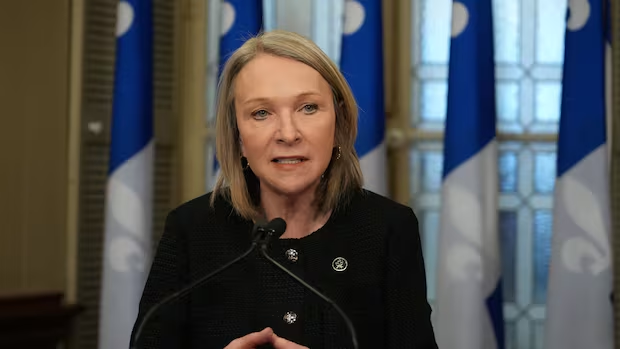
Quebec Health Minister Sonia Bélanger has tabled a new bill to change doctors’ remuneration after reforms outlined in Bill 2 threatened clinic closures and the departure of GPs to other provinces.
MNAs will begin to study Bill 19, titled An Act to, in particular, improve access to medical services and provide for the medical taking in charge of the population. Reforms from the bill are expected to take effect on Feb. 28.
Family physicians and medical specialists have been at odds for months over Bill 2, legislation that ties a portion of doctors’ pay to collective performance targets.
The Coalition Avenir Québec (CAQ) government passed legislation in December delaying the implementation of Bill 2 until Feb. 28. It had been scheduled to go into effect Jan. 1.
Bill 19 is meant to formalize the tentative deal the Quebec government reached with family physicians last December, Bélanger said at a news conference in Quebec City on Wednesday.
“We all agree on one thing: vulnerable patients must see a doctor directly. Doctors agree with this,” Bélanger said.

The Coalition Avenir Québec government has tabled a new piece of legislation that vows to improve Quebecers’ access to health care after a special law on doctors, Bill 2, was overhauled last year.
GPs, GMFs would take on 500,000 patients by June
Some of the major amendments Bill 19 brings include removing the obligation for family doctor groups, known in French as GMFs, to take on the province’s estimated 1.2 million orphaned patients by January 2027.
Bill 19 calls for family doctors and GMFs to take on 500,000 patients who still don’t have a family physician by June 30, including 180,000 patients the government deems vulnerable. This performance target is voluntary, however, and tied to incentives worth $76 million.
The tentative agreement with the Fédération des médecins omnipraticiens du Québec (FMOQ) entails that with a few exceptions, physicians’ compensation would be split as follows: 50 per cent as a fixed amount per patient, 30 per cent fee-for-service and 20 per cent hourly rate.
The agreement also provides for a 14.5 per cent increase to the overall compensation envelope for family doctors by 2028, representing $435 million.
Negotiations between the province are ongoing between the government and the province’s medical specialists, the Fédération des médecins spécialistes du Québec (FMSQ).
Asked whether the government may table another bill to reflect a potential agreement with the FMSQ, Bélanger said, “anything is possible.”
She noted that the compensation model for medical specialists won’t be as affected as those of family doctors.
“We’re not talking about capitation for specialists,” she said. “The compensation model itself isn’t being changed. Other elements will be addressed in the negotiations.”
Bill 19 suggests willingness to co-operate: family doctor
Dr. Benoît Heppell, a family physician based in Sherbrooke, Que., said Bill 19 shows the government and the FMOQ want to work together.
“At this moment, nobody wants to play in this movie again in two or three years for sure,” Heppell said, noting that the next provincial election is in October. “Everybody around the table wants the job done correctly.”

At the province’s National Assembly, MNAs rushed to adopt one final piece of legislation before taking their winter break — one that postpones the start date of the CAQ’s controversial health reform law. It had caused a bitter, months-long battle with doctors, and details emerging from the government’s tentative deal with family doctors show a Legault government willing to drop many of the law’s most contentious measures.
Heppell added that he hopes the money the FMOQ will receive through its agreement with the government will be used to encourage new physicians to pursue family medicine rather than emergency.
However, Québec Solidaire health critic Guillaume Cliche-Rivard questioned how the new payment model would prevent doctors from leaving the province’s public sector.
“After months of unnecessary drama, Minister Sonia Bélanger is revisiting several mistakes made by her government last fall,” Cliche-Rivard said in a media statement published Wednesday.
“The CAQ should have introduced this bill from the outset; it would have prevented doctors from leaving and patients from panicking.”