
Listen to this article
Estimated 5 minutes
The audio version of this article is generated by AI-based technology. Mispronunciations can occur. We are working with our partners to continually review and improve the results.
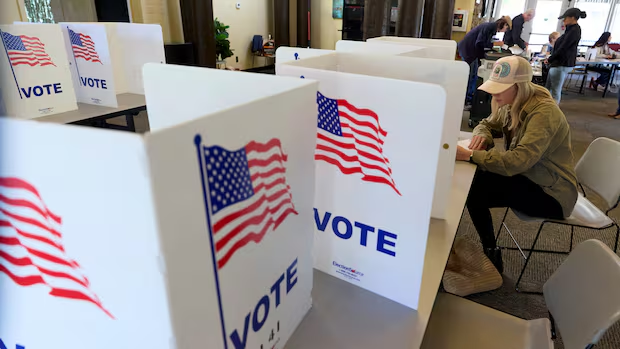
The U.S. Supreme Court allowed California on Wednesday to use a new electoral map designed to give Democrats five more congressional seats, improving the party’s chances of regaining control of the U.S. House of Representatives from President Donald Trump’s Republicans in the November midterm elections.
The justices denied the California Republican Party’s request to block California’s map, which was endorsed by voters last year as a counterweight to a similar effort in Texas aimed at giving Republicans five more U.S. House seats. The Supreme Court, which has a 6-3 conservative majority, in December allowed Texas to use its redrawn map for this year’s voting.
The court’s one-sentence order did not offer any explanation, as is common in actions that it considers on an emergency basis. No justice publicly dissented from the decision.
The California Republican Party and other challengers claimed that the state unlawfully used race in redrawing the boundaries of its U.S. House districts.
Redrawing the boundaries of electoral districts in a state is a process called redistricting. The California dispute represents another front in an ongoing nationwide battle over redistricting that Trump began last year with his campaign for Republican lawmakers to redraw state congressional maps, starting with Texas, to help protect the party’s narrow U.S. House majority in the midterm elections.
Trump ‘started this,’ Newsom says
The Supreme Court ruled in December to let Texas proceed with its new map.
“Donald Trump said he was ‘entitled’ to five more congressional seats in Texas. He started this redistricting war. He lost, and he’ll lose again in November,” said California Gov. Gavin Newsom, a Democrat, in a social media post after the decision.
Republicans currently hold slim majorities in both chambers of Congress. Ceding control of either the House or Senate to the Democrats in the November 2026 elections would endanger Trump’s legislative agenda and open the door to Democratic-led congressional investigations targeting the president.
The new Texas map could flip as many as five currently Democratic-held House seats to Republicans. Democratic-governed California reacted to the Texas redistricting move by initiating its own effort that could flip five Republican-held districts in the state to Democrats.
California voters last November approved a ballot measure to allow lawmakers to adopt the new map. California, the most populous U.S. state, has 52 seats in the House. Texas, the second most populous state, has 38.

After Texas sparked controversy for securing five additional House seats by redistricting its congressional maps, California responded with some gerrymandering of its own. Andrew Chang breaks down how gerrymandering works and how it could affect the outcome of the 2026 midterm elections.
Images provided by The Canadian Press, Reuters and Getty Images
Constitutional concerns
The Republican plaintiffs, joined by Trump’s administration, sued in Los Angeles federal court to block the new map, claiming it used “race as a predominant factor” to favor Latino voters, in violation of the U.S. Constitution’s 14th Amendment guarantee of equal protection under the law, 15th Amendment prohibition on racial discrimination in voting and the federal Voting Rights Act.
That federal court on January 14 refused to block the map.
“Because we find that the evidence of any racial motivation driving redistricting is exceptionally weak, while the evidence of partisan motivations is overwhelming, challengers are not entitled to preliminary relief on any of their claims,” the court said in a 2-1 decision.
The Republican plaintiffs told the Supreme Court that state officials sought to “shore up Latino support for the Democratic Party” through the “pernicious and unconstitutional use of race.” In a separate filing, Trump’s administration said, “California’s recent redistricting is tainted by an unconstitutional racial gerrymander.”
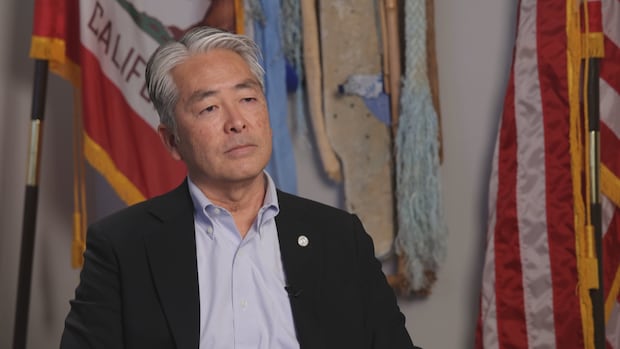
Al Muratsuchi, a Japanese American assemblymember for California, says the goal of Donald Trump’s immigration crackdown goes beyond deportation to create ‘an overall atmosphere of fear,’ especially after incidents like U.S. Sen. Alex Padilla being tackled and the National Guard being sent into Democratic cities.
States typically create new maps each decade to reflect new census data, though the recent rounds of redistricting have been motivated by securing partisan advantage, a practice also known as partisan gerrymandering.
The Supreme Court in 2019 removed a key constraint against the practice, which critics have said warps democracy, in a ruling that declared that such actions cannot be challenged in federal courts.
California Attorney General Rob Bonta’s office in a filing urged the justices not to be naive.
“The obvious reason that the Republican Party is a plaintiff here, and the reason that the current federal administration intervened to challenge California’s new map while supporting Texas’s defence of its new map, is that Republicans want to retain their House majority for the remainder of President Trump’s term,” California’s filing stated.
The court should not “step into the political fray, granting one political party a sizeable advantage by enjoining California’s partisan gerrymander after having allowed Texas’s to take effect,” it added.
The Supreme Court’s decision to green-light the Texas redistricting effort, over the dissent of the court’s three liberal justices, appeared to acknowledge the political motivations of both that state and of California.
Conservative Justice Samuel Alito additionally wrote in a concurring opinion in that case that it was indisputable that the “impetus for the adoption of the Texas map (like the map subsequently adopted in California) was partisan advantage, pure and simple.”