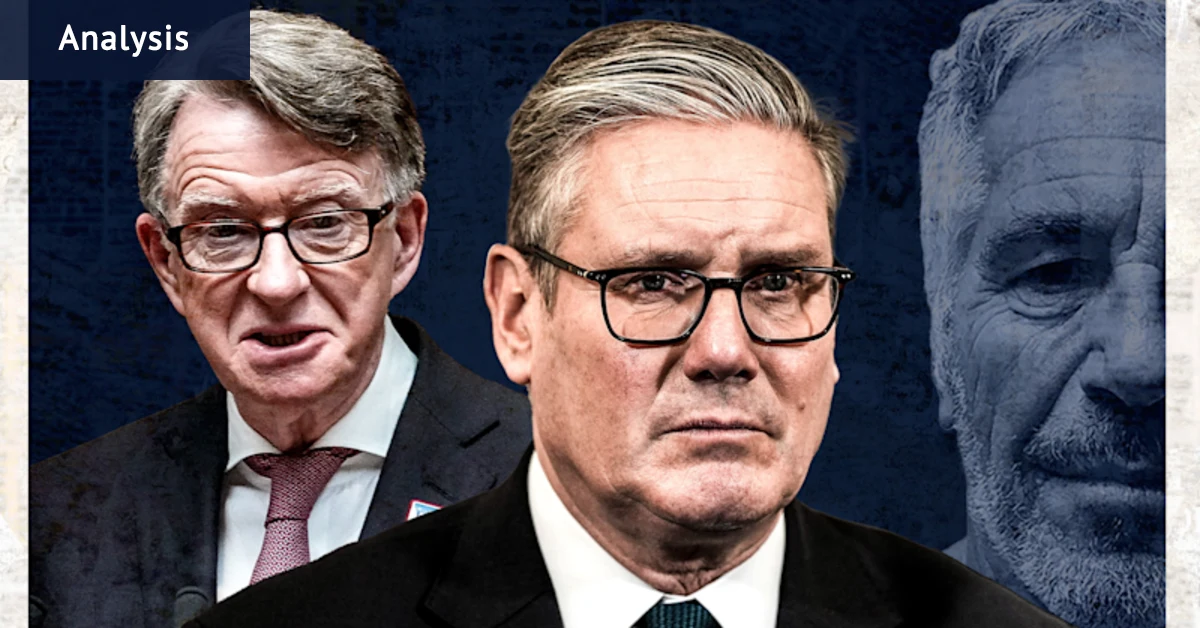

London: Keir Starmer leads a Labour government with a crushing majority in parliament and a divided opposition that is waging a daily war between conservatives and populists.
The UK prime minister has, on paper, the same advantages as his friend, Anthony Albanese. Just as the Australian leader can walk into parliament and enjoy the sight of Liberals and Nationals eating each other alive, Starmer can watch the Conservatives and Reform UK cannibalise their voters.
And yet Starmer is now the target of open speculation about a leadership challenge. He leads a fractious Labour Party that is tearing itself apart, less than 20 months after it swept into power with more than 400 of the 650 seats in the House of Commons. While Labor in Australia enforces discipline, Labour in Britain erupts in division.
Now the Epstein scandal looks like the final straw for a mutinous party. Starmer is exposed for his decision to appoint one of Jeffrey Epstein’s associates, Peter Mandelson, as the British ambassador to Washington DC at the end of 2024.
Mandelson was removed last September when documents showed how close he was to the convicted sex offender, but this has not been enough to protect Starmer after the release of so much cringeworthy detail in the document dump from the US Department of Justice last Friday.
The latest emails and documents show that Mandelson was not just a friend who turned up at Epstein’s island. He was in constant touch on business and politics. As a Labour minister more than a decade ago, he sent Epstein confidential documents from within the British government. He is now the subject of a police investigation.
And Starmer is the subject of questions about his judgment in appointing Mandelson to such a key position.
This was clarified on Wednesday in the House of Commons when the Conservative leader, Kemi Badenoch, asked Starmer about the security advice he had received before naming Mandelson in the post.
“Did the official security vetting he received mention Mandelson’s ongoing relationship with the paedophile Jeffrey Epstein?” she asked.
“Yes, it did,” Starmer answered. He said questions were put to Mandelson and promised to release this information to the House. He added: “So it will see for itself the extent to which, time and time again, Mandelson completely misrepresented the extent of his relationship with Epstein – and lied throughout the process.”
This might be enough to save Starmer. He has condemned Epstein and described Mandelson’s leaks as a betrayal of the nation. He blames Mandelson for deceiving the government when it tried to check on his ties to the sex offender.
The problem is that Mandelson’s link to Epstein was known years ago. It emerged in court proceedings (such as a case regarding JPMorgan) well before any Department of Justice document releases. It was written about in the press, even though the full details were hidden.
Starmer appointed Mandelson anyway.
A leader with full authority could ride out this storm. Starmer, however, has little authority left. He has struggled to set a direction for his government. His office conveys instability by hiring and firing advisers, blaming them for dud decisions. But every political office is shaped by the personality of its leader.
This is not all the leader’s fault. Starmer presides over a large and fractious parliamentary party that was unready for government after 14 years in opposition. The Labour backbench jumps and scatters at every hard decision, whether it is on welfare reform or tax.
While the Australian Labor Party uses the iron will of the left and right factions to keep order, the Labour Party lacks these twin pillars. It has a complex structure and fewer sanctions on dissent. Right now, it looks like an unruly collective.
Labour could, in theory, hold its nerve and keep governing. The next national election is not due until August 2029. But the government is behind in the opinion polls, and 68 per cent of voters say they dislike Starmer, according to polling firm YouGov. And Reform UK leader Nigel Farage sets the agenda with his populist appeal on migration and his declaration that Britain is broken.
So the date that matters is not in 2029 but in 2026. Labour MPs look terrified of the elections due on May 7 for parliaments in Scotland and Wales, as well as local councils. A drubbing for Labour would be a defeat for Starmer.
Leadership questions grow
Leadership speculation is rife. The major newspapers, from the left and the right, are full of Labour MPs speaking on background about Starmer’s poor judgment and the merits of various ministers who could replace him.
The backgrounding presents the contenders as serious options, and much of the media falls for this, but the choices all have flaws. One of them, Angela Rayner, a left-wing firebrand, had to quit as deputy leader only five months ago because she did not pay her taxes properly.
Another, Wes Streeting, appeals to centrists but is only 43 and has barely been a minister for 18 months. A third, Andy Burnham, is the Mayor of Greater Manchester and not even in the Commons. (He was, at least, a minister for three years until 2010.)
Labour, as a party of government, looks panicked and paralysed. Australians will guess where this is going. Just as Labor splintered in Canberra over the choice between Kevin Rudd and Julia Gillard almost 16 years ago, Labour in the UK seems about to crack over the argument about Starmer.
That is why this is so bizarre. Labour saw the damage from feuding among its Australian friends from 2010 to 2013, and it saw the Conservatives implode over 14 years in power with four leaders from David Cameron to Boris Johnson, Theresa May and Rishi Sunak. Yet it is heading toward the same civil strife.
The despair has reached a stage where some MPs are intent on dumping Starmer, despite their doubts about the alternatives. That is partly because the Mandelson affair makes it look as if the core problem is the prime minister, and the solution is to swap him out for another one.
If this happens, they are likely to discover that a government’s first spill is not the end of the agony. Often it is just the start.
Get a note directly from our foreign correspondents on what’s making headlines around the world. Sign up for our weekly What in the World newsletter.
 David Crowe is Europe correspondent for The Sydney Morning Herald and The Age.Connect via X or email.