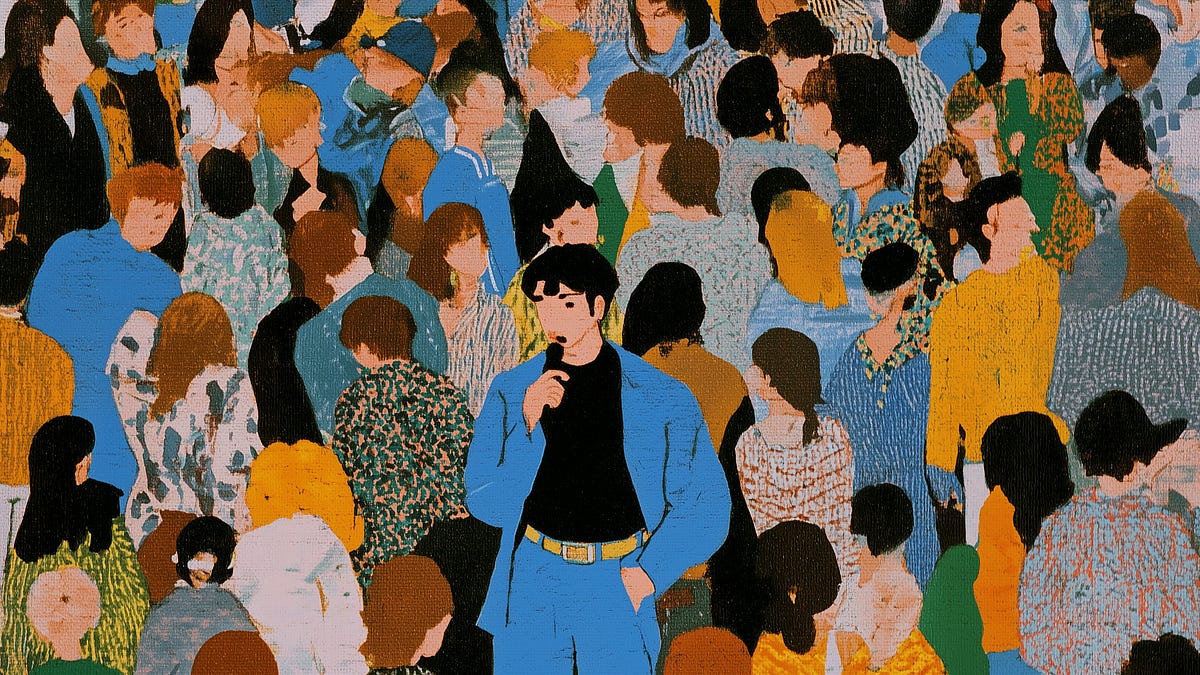
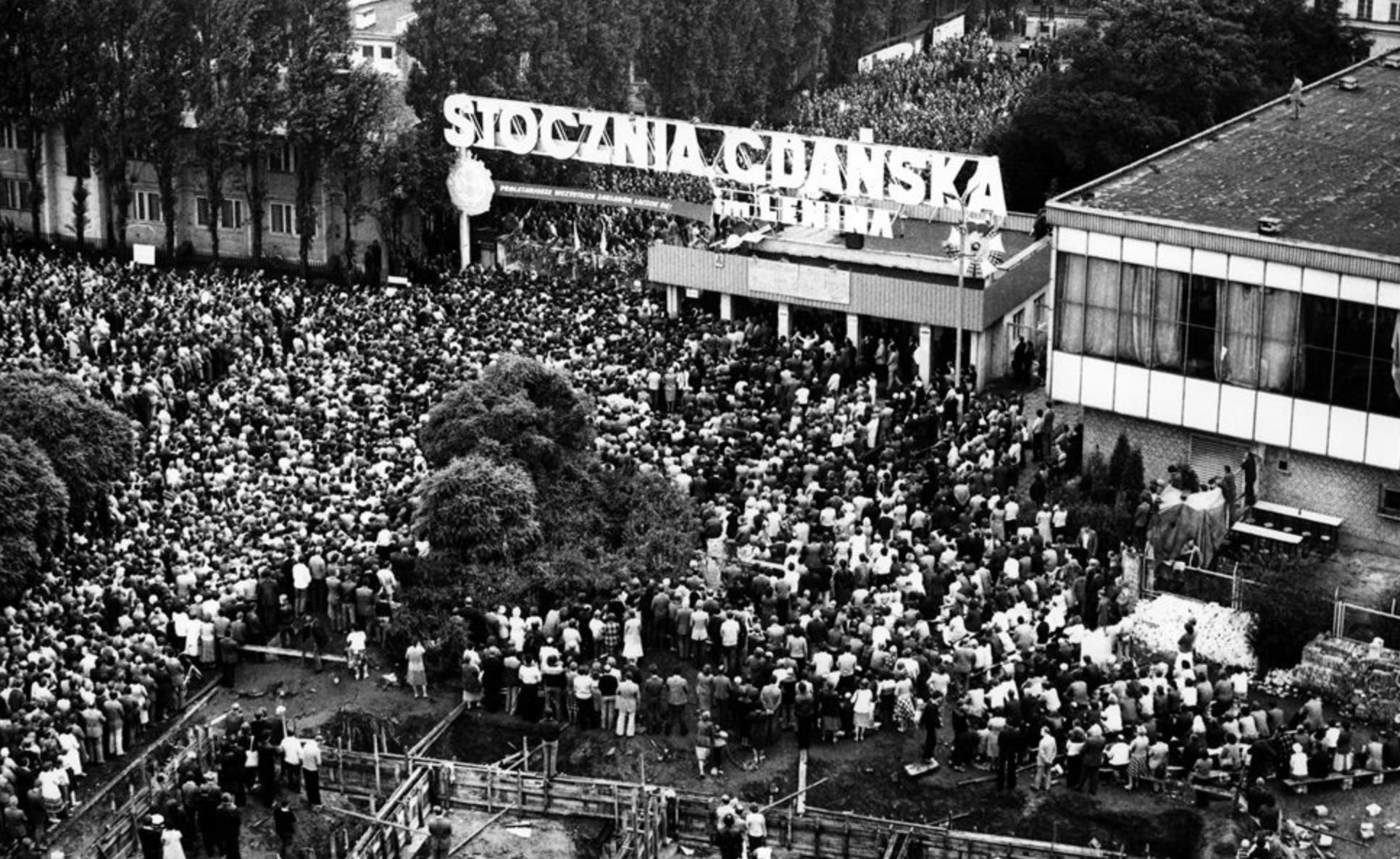
An actor recites a poem from a makeshift stage. 16,000 striking workers mouth the words along with him, another 20,000+ civilians gathered outside the locked gates in an atmosphere of a calm festival. It’s a scene from a strike that has been running for nearly 2 weeks, an inflection point of what will become one of the most successful acts of resistance in history.
It’s August 1980 in Gdańsk, Poland. A shipyard strike is underway, sparked by a decade-long cultural movement that, 9 years later, led to the fall of the Soviet Union.
Do not feel safe. The poet remembers. (…) The words are written down, the deed, the date. – Czesław Miłosz, “You Who Wronged”
It wasn’t sparked by a sudden outburst, but made inevitable by 10 years of small acts of rebellion, cultural rather than political. How do you encourage and coordinate thousands of people across the country – without access to broadcast through press, TV, or radio, all controlled by the government – to trudge along for 10 years doing the same small things, over and over again, without seeing impact?
Polish people explicitly acted as if it didn’t matter if the individual actions had any effect. Ironically, this shared culture became the foundation that allowed a revolution to grow.
The seeds had been planted many years before. Two weeks before Christmas in 1970, government proposed to raise food prices by 30%+. Christmas is a holiday central to Polish culture, focused on three days of eating and drinking with family. Workers came out to protest at the exact same shipyard; dozens of them were shot by the military.
It would be a while before anyone braved direct confrontation, but many refused to sit silently, either. Leszek Kołakowski was one of them.
“The cultural role of philosophy is not to deliver the truth but to build the spirit of truth, and this means never to let the inquisitive energy of mind go to sleep, never to stop questioning what appears to be obvious and definitive, always to defy the seemingly intact resources of common sense, always to suspect that there might be “another side” in what we take for granted, and never to allow us to forget that there are questions that lie beyond the legitimate horizon of science and are nonetheless crucially important to the survival of humanity as we know it.” – Leszek Kołakowski, 1971
His role as a chief revolutionary philosopher had an unusual start. As a young, bright-eyed, bushy-tailed Marxist, he was plucked out of the rising communist intellectuals to visit Moscow. Purpose: cross-pollinate ideas with the soviet culture.
Attending lectures at the Institute of Social Sciences in Moscow, his expectation was to experience something he called a “Rome of Communism” – intellectual sparring, collaboration with other academics, debates on how to Change the World with the ideals he (and presumably everyone there) believed in.
It did become a defining moment of his life, but not in the sense he had expected.
What he saw instead were professors who refused to engage in debate, intellectually dead, paralyzed with fear that whatever they say might deviate by one word too many from the official messaging, putting their families in danger. Outside of academia, he saw Moscow to be a land of “material and spiritual desolation”: people were dirt poor, hopeless, and broken.
In 1971, Kołakowski publishes On Hope and Hopelessness, and it quickly becomes a guide on how to lead resistance, and why culture matters more than power and politics in bringing a major, permissionless change.
From a publication-in-exile in Paris, smuggled through underground printing presses and distribution networks across Poland, into the hands of thousands of dejected workers who struggled to make ends meet and see a path to a better future, Kołakowski says: refuse to settle. Humans have no ability to estimate how much capacity for change there is in a system.
He urged: refuse to believe that what you do only matters if you can directly quantify the results. Change is a slow erosion of what’s not working. Keep watch, and you will see that all systems function poorly in some places, and those are the cracks to shove a crowbar into and start chipping away. You better believe that things can change and act as if they will, otherwise you’ll be right that they won’t.
If you accept this, then the question becomes: what sort of actions do you take? Kołakowski’s answer was cultural, not political.
By the time mid-70s rolled around, the generation of 20-somethings was stuck, frustrated, and generally dejected. They had left schools to be the glorified workers of the industry. They grew up listening to platitudes about the Heroes of Labor. As they were starting their careers, they were dealing with unhealthy and unsafe working conditions, wage inequality of 40:1, and a bloated, incompetent, unresponsive management.
It was easy to decide that the only solution is to overthrow the existing system by any means necessary, as quickly as possible; to try out a bunch of heroic big ideas, which (inevitably) get suffocated under the government repercussions and the internal squabbles over the right politics.
But that’s not what happened.
They refused to set a political agenda. Instead, what eventually became the Solidarity movement, focused on something simpler: that life universally sucked for everyone. The underground activity didn’t plan a coup, but distributed independent press, poems, essays (among them, On Hope and Hopelessness, or illegally-translated copies of 1984 and Animal Farm). This was cultural infrastructure, not a political strategy, and it had an unexpected effect: people who had been stuck inside stiff political labels started to see that the future was bleak for everyone. Previous identity of “left” and “right” or “intellectual” vs. “worker” stopped mattering as much as the shared conviction that something needed to change. These networks soon became the foundations for newly-minted activists to collaborate.
Reading about the socioeconomic conditions for young people in the 1970s Poland sounds eerily familiar to what many of us are feeling: education and experience that don’t translate to rewarding work, exposure to standards of living that are permanently out of reach, an unstable economy, worsening support networks like medical care. This is not meant to be a strict comparison; Poland was occupied and materially desperate in many ways that don’t apply here. But the texture feels similar, with the economic anxiety, high inequality, and unresponsive institutions.
We might have an additional disadvantage, though: we’ve spent the last few decades in a hustle culture focused on near-immediate returns on investment, the exact opposite to small acts, performed over a long time, leading to a hard-to-predict change.
This unobvious impact of culture doesn’t apply just to politics. Take a pretty distant example of the 19th century romanticism, which purposefully ditched prioritizing the economic and industrial output above all else, frustrated with how it centralized economic power. Instead, it focused on the emotion, the supernatural, the awe and terror, nature, the exotic worlds and nightmares, the importance of humanity.
This shift to the purposefully “unproductive” eventually laid the groundwork for changes that would have been hard to predict: protections for workers, laws against child labor, and abolitionism. Ironically, over the next century, it enabled breakthroughs in psychology (the unconscious), science (ecology and environmentalism), industry (creative economy and pop culture), and even tourism-as-an-industry – capitalistically “productive” outcomes from a movement that had explicitly rejected productivity.
We tend to think of change as rapid and revolutions as explosions. Pressure gets too high, so the solid, concrete foundations of an unacceptable system must go out immediately. But the Polish experience paints a different picture, of hundreds and thousands of undeterred tiny poking at a wall, picking away at the visible scabs, until it deteriorates so much it has to fall.
Kołakowski died in 2009, twenty years after the wall came down. He’d written more than thirty books, popularizing philosophy and encouraging people to ask questions. He described the jester as an essential figure in philosophy: someone unafraid to challenge assumptions, maintaining a healthy distance from everything. I don’t know if he ever wrote about what it felt like to watch the thing he’d insisted was possible actually happen – or whether, by then, he’d moved on to doubting something else. His work wasn’t to be proven correct, but to “never let the inquisitive energy of mind go to sleep.”